




Take heed to the interview with Kareem Farah:
Sponsored by Hapara and Kiddom
Most academics can relate to that sinking feeling you get if you forge forward to a brand new lesson though a lot of your college students aren’t “getting it.” The pacing information says it’s time to maneuver ahead, there’s a deliberate evaluation only a week away, and you’re feeling compelled to maintain pushing by means of. However you recognize that isn’t what’s greatest for youths. Abilities construct on one another. Children can’t dash earlier than they stroll. They will’t write a paragraph earlier than they write a sentence.
Finally, each educator desires to create a classroom that honors the truth that college students should first grasp foundational expertise to entry extra complicated content material. However we don’t present them with a blueprint for easy methods to do it. We anticipate mastery from college students, however don’t create the situations that give them the time and help to realize it.
The excellent news is, the ultimate frontier of the blended, self-paced, mastery-based mannequin we now have created on the Fashionable Lecture rooms Challenge addresses this very problem. On this piece, I’ll lay out the buildings and programs it is advisable to domesticate a mastery-based classroom of your personal. With the rising variety of educational and social-emotional wants as a consequence of the COVID pandemic, a mastery-based method is not only invaluable, it’s vital.
The Worth of Mastery-Based mostly Grading
Earlier than you make the leap into remodeling your classroom round mastery-based grading, it’s essential to know why it’s so invaluable. At its core, mastery-based studying refers back to the notion that college students should meet a sure stage of competence for a job or ability earlier than shifting on to the subsequent. Apart from it sounding fairly wise, there are some core the reason why mastery-based grading is actually invaluable for college students:
- Prevents lingering ability gaps: Each instructor is aware of what it’s like to start out a lesson, solely to comprehend a couple of minutes in that plenty of college students aren’t prepared for it. That is the consequence of sustained ability gaps. Children have been pushed by means of class after class and lesson after lesson with out attaining precise mastery. We collectively sweep foundational ability gaps below the rug, figuring out that finally it will create challenges for college students when introduced with extra complicated expertise. It additionally results in monumental variability in studying ranges inside the similar classroom, faculty, or district. It’s no shock that when mastery-based grading is applied successfully it’s related to a lower within the quantity of variability in aptitude between college students (Anderson, 1994; Kulik, Kulik, & Bangert-Drowns, 1990). Furthermore, it results in a considerable improve in college students’ skill to retain their studying long-term, thus making certain they’re arrange for fulfillment after they depart your classroom (Kulik, Kulik, & Bangert-Drowns, 1990).
- Builds pupil confidence: Mastery-based grading is integral to constructing college students’ sense of self-worth within the classroom. Children aren’t oblivious to the truth that they’re being moved on from one lesson to the subsequent with out really totally greedy the ability. In truth, each time they do get pushed ahead with out attaining mastery, they query whether or not or not they’re holistically “good” at a specific topic. When this occurs again and again, they query whether or not they’re even able to educational success. In a mastery-based setting, the place college students are given a real alternative to succeed, they develop extra constructive attitudes towards the content material being taught. (Anderson, 1994; Kulik, Kulik, & Bangert-Drowns, 1990). Extra importantly, they begin to imagine in themselves as younger students and finally enhance their educational self-concept (Anderson, 1994; Guskey & Pigot, 1988).
- Prepares college students for the true world: In my first few years as a classroom instructor, I assumed one of the best ways to help my college students was to only give them the whole lot they wanted. I shielded them from productive wrestle, I didn’t require mastery, and I conditioned them to imagine completion and energy had been adequate. On the time, I assumed I used to be doing what was greatest for youths, solely to comprehend later I had allow them to down. I misrepresented how they might be handled after they left my classroom and traveled on to varsity or the office. In these settings, they felt blindsided when abruptly they had been held to mastery. They wanted to point out competence and had been anticipated to be self-aware sufficient to determine after they wanted to interact in additional studying or hunt down further help. After we don’t maintain our college students accountable to mastery, we fail to arrange them for what’s subsequent in life. We promote them a false actuality that may solely harm them in the long term and generally when it’s too late.
Setting the Situations Wanted for Mastery-Based mostly Grading
It may be onerous to think about easy methods to implement mastery-based grading when you will have by no means accomplished it earlier than. The core limitation is the attachment most educators must fixed-pace studying. To implement mastery-based grading you must problem the established order of conventional programs the place all college students have the identical period of time to realize competence. As an alternative, in mastery-based studying every pupil continues to spend time on a ability till they obtain proficiency (Dick & Reiser, 1989).
For that to develop into a actuality, educators have to infuse parts of self-pacing of their classroom to allow them to let some college students work on one lesson whereas others transfer on to the subsequent as a result of they’ve achieved mastery. As an alternative of taking a look at a unit and saying college students NEED to study lesson #1 on Monday and lesson #2 on Tuesday, we have to honor the truth that studying simply isn’t that inflexible.
Now I may write a complete piece discussing easy methods to construct a self-paced classroom, and the excellent news is I’ve! To learn the way, discover our free on-line course* or learn my earlier piece right here on Find out how to Create a Self-Paced Classroom.

The Two Levels of a Scholar’s Journey In direction of Mastery
After getting established the situations essential to grade college students on mastery, then it’s time to design the programs essential to make it occur. Reaching mastery is a journey and usually entails two levels:
Stage 1: Growing Mastery By Apply
As quickly as a pupil is uncovered to a brand new ability, they should apply that ability. The apply stage must be the place they spend nearly all of their class time. It’s when college students are actually growing their understanding of the fabric. Designing efficient alternatives for apply ought to embody:
- Utility of the Materials: For apply to be productive, it should embody utilized studying. This may be accomplished by means of discussions, labs, readings, worksheets, and different actions. A few of the greatest types of apply are pushed by inquiry and fixed questioning. The expertise must be scaffolded so college students are systematically participating in more difficult work because the lesson builds, bringing the scholar nearer and nearer to mastery.
- Alternatives for Collaboration: Ideally, apply time is collaborative. College students ought to give you the chance work collectively to know new content material and ask inquiries to friends who might have already mastered the ability. In an efficient mastery-based setting, educators are additionally working to construct college students’ skill to be self-regulated learners. As an alternative of operating a teacher-centered classroom, college students must be on the middle and academics ought to function a information as college students lean on one another by means of the journey to mastery.
- Fixed Revision: One of the necessary parts of constructing an efficient mastery-based grading classroom is cultivating a tradition of revision. College students have to internalize that to realize mastery it is best to EXPECT to revise your work. This can be a novel idea to many college students and can end in some pushback, which is an efficient factor. Throughout this apply time, college students must be submitting assignments and receiving suggestions from their instructor on areas that want enchancment. Not like a conventional setting, the place college students flip in assignments and by no means see them once more till they’re “graded,” in a mastery-based classroom, college students are always revisiting their task till they perceive the fabric sufficient to show their mastery. To revise successfully, college students ought to obtain clear suggestions on what they do and don’t but perceive. They need to additionally obtain actionable strategies for what they need to do to progress to the subsequent section of the training course of the place they’ll show mastery.
Stage 2: Demonstrating Mastery By Mastery Checks
As soon as a pupil has practiced sufficiently, it’s time for them to show that they honestly are a grasp of the ability! To supply college students with this chance, educators have to design efficient assessments that enable college students to show their understanding of a given ability or idea.
We name these assessments “mastery checks,” and college students take them on the finish of every lesson previous to shifting on to the subsequent one. They emulate the perform of an exit ticket however aren’t administered on the finish of a category interval. As an alternative, mastery checks are administered when a pupil has practiced the content material adequately and feels prepared to point out their understanding of the content material in a managed setting. Designing efficient mastery checks is integral to operating a mastery-based classroom. Listed here are some necessary traits to think about:
- Administered Individually: Not like the collaborative apply stage, college students take mastery checks independently. It’s college students’ alternative to point out that they will execute the ability with out the help of their friends. Mastery checks are taken every time college students are prepared for them, so you’ll usually have plenty of college students demonstrating their mastery on totally different classes on the similar time. To handle the workflow and cut back the probabilities of dishonest, many educators create a “Mastery Test Zone” of their classroom. That space of the classroom is totally silent and reserved for college students who’re demonstrating mastery.
- Simply Assessed: At this level, you’ll be able to in all probability inform {that a} mastery-based studying setting requires a good quantity of grading. The secret is the grading is purposeful and results in actual data-driven instruction. To assist handle the movement of labor, you will need to construct mastery checks which are straightforward to evaluate. These are ideally bite-sized and do a pleasant job of balancing depth of understanding with environment friendly evaluation. We encourage educators to make use of a mastery verify template to maintain a constant construction. Remember the fact that mastery checks don’t all should be the identical format or be delivered in the identical medium. They will appear to be a mini-quiz, a sorting exercise, or verbal assessments. As a instructor, you’ll know greatest what a pupil must do to show their understanding of a ability.
- Alternative for Reassessment: The heartbeat of an efficient mastery-based grading setting is reassessments. College students and academics ought to all come to the collective understanding that a part of the journey to mastery is often falling quick on assessments, reflecting on why, after which re-demonstrating mastery. To do that successfully, academics develop a transparent understanding of what constitutes mastery after which maintain college students to it. To help this course of, plenty of educators construct rubrics for his or her mastery checks to make sure the grading course of is as environment friendly as attainable and the proof is obvious when a pupil must be reassessed.
Many educators construct a number of types of every mastery-check to permit for straightforward reassessment. That is extremely contingent on the content material space. For instance, in math lessons the place college students are studying about components, it’s fairly simple to construct a number of types of the identical mastery verify. Alternatively, in an English class the place college students are studying about character and theme, it could make extra sense to easily have college students revisit the identical mastery verify if they didn’t obtain mastery.
Keep in mind that there isn’t a one universally accepted technique to executing a mastery-based grading system. You’re the professional within the room and perceive greatest what’s going to be just right for you and your college students. After getting a plan, be sure that to articulate it clearly to your college students. Nothing ought to really feel like a shock.
Getting ready for Pushback and Challenges
As with all necessary and progressive shift you make within the classroom, it is best to anticipate pushback and setbacks. Conventional practices in educating and studying have remained in place as a result of they’re comfy and infrequently handy. Don’t be stunned if college students, mother and father, colleagues, and admin specific hesitation about your imaginative and prescient. Extra importantly, anticipate to have your personal doubts all through the method. Put together your self for these frequent transition challenges:
1. Scholar Frustration
Most college students have spent their academic profession in environments that didn’t anticipate mastery; they’re used to shifting on to the subsequent lesson no matter competency. So after they enter a mastery-based setting, they’ll inevitably be stunned and fairly pissed off. The primary time they’re requested to revise or be reassessed, they may ask why and in some circumstances specific anger that you just aren’t merely simply shifting them on. Any such response is all of the extra purpose we have to transfer ahead with mastery-based grading. That is good pushback, a sign we’re actually altering college students’ notion of studying in a manner that has long-term constructive impacts. The secret is to not be stunned by it and to be ready to articulate the rationale for the shift. The extra pissed off your college students get, the extra they possible have to study this shift earlier than it’s too late.
2. Working with Conventional Gradebooks
Usually on the Fashionable Lecture rooms Challenge we subject questions concerning whether or not a mastery-based grading method can work with a conventional gradebook. I can guarantee you the 1000’s of educators who’ve applied our blended, self-paced, mastery-based method achieve this in conventional colleges and districts that require A-F grades quarterly. The shift you make is essentially centered round the way you really deal with grading every particular person task and mastery verify.
Take the instance of a unit with 5 classes and a summative evaluation. Let’s assume every lesson has an related task (scored out of 10 factors) and mastery verify (2 factors) and the summative evaluation is a take a look at (50 factors). In a conventional fixed-paced classroom the place college students aren’t graded primarily based on mastery, a pupil may get the next grades:
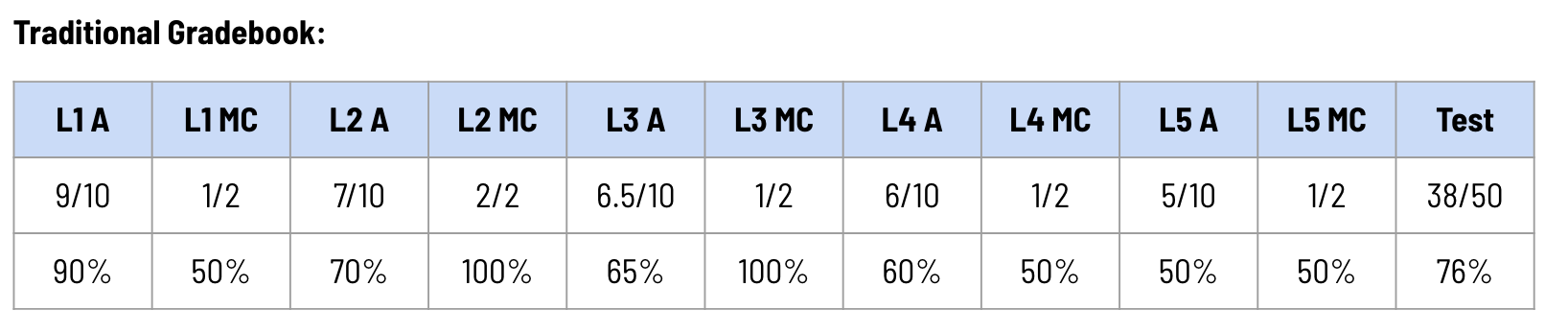
The issue with a construction like that is college students and academics alike don’t really know what classes have been mastered. The partial credit score grades inform us little or no a few pupil’s competence of expertise. It finally results in a letter grade that’s onerous to clarify.
Alternatively, in a mastery-based grading system, you should utilize the very same grading construction, however merely solely award college students with credit score if they’ve achieved mastery. Due to this fact, a pupil may get the next grades:

The fantastic thing about this method is each college students and academics know precisely what expertise children do and don’t perceive. On this instance, the scholar mastered Classes #1-4 however not #5. Naturally it’s going to even be mirrored within the summative evaluation the place the scholar scored an 82%, which is predicted given they mastered 80% of the lesson.
One factor to notice is that the majority educators we help by means of our mannequin solely self-pace inside every unit of examine and nonetheless give summative assessments at a scheduled time. They normally grade these “historically” and use them as a chance to mirror with their college students and craft a plan for addressing college students’ gaps in understanding.
3. Retaining Up with Grading
As an educator who spent my first 3 years within the classroom educating historically, I HATED grading. It was actually mundane, however worse, it didn’t really feel purposeful. I wasn’t utilizing the knowledge to drive my instruction. By the point I handed again work, my college students had already forgotten about what they did. It felt like busy work that took up manner an excessive amount of time.
In a mastery-based grading setting, there’s a honest quantity of grading. Academics usually specific that maintaining could be difficult. However the grading really issues. It drives the discussions you will have with college students in small teams and individually. It triggers revisions and reassessments the place college students use your suggestions to revisit expertise to construct competence. There isn’t a silver bullet to cut back the grading load. Some academics leverage tech-based evaluation to speed up the grading. Others spot verify assignments and focus their power on mastery checks for effectivity. Finally, you’ll strike the fitting steadiness, and can derive aid and pleasure from the truth that grading really feels purposeful! (Take heed to our podcast on managing grading right here.)
The place to go to study extra
Making a classroom constructed round mastery-based grading is difficult! It requires considerate planning, detailed grading and a dedication to doing what’s greatest for youths even when there may be pushback. I can guarantee you the advantages outweigh the challenges. Each I and the academics we now have skilled on the Fashionable Lecture rooms Challenge can attest that the transformation to a mastery-based grading method has lasting impacts on college students’ perceptions of studying and their sense of self-worth. For college students to imagine in themselves, they should be given the time and house to really show their excellence.
For those who’re excited about launching a mastery-based classroom of your personal, a fantastic place to start out is our free on-line course. The course supplies an in-depth overview of our blended, self-paced, mastery-based tutorial mannequin full of templates, tutorials, exemplar models and different helpful sources. Moreover, you’ll be able to hear from actual Fashionable Classroom academics and mentors as they share about their expertise by listening to our Fashionable Lecture rooms Challenge Podcast.
Lastly, in the event you’d like extra structured help as you make the leap into mastery-based grading, take into account enrolling in our Fashionable Classroom Mentorship Program. As a part of this system, you’ll be paired with a mentor and obtain 1-on-1 teaching, suggestions on tutorial supplies and plans you create, and ongoing help from the broader Fashionable Lecture rooms neighborhood. Most significantly, you’ll depart this system able to launch a mastery-based studying setting of your personal.
No matter the next move in your skilled studying journey, problem your self and the numerous assumptions we now have made about grading practices in schooling that don’t contribute to learner understanding. Extra importantly, work to carry your college students to mastery as a result of they deserve nothing much less. After we maintain college students to excessive expectations, they rise to the event.
References
Anderson, S.A. (1994). Synthesis of analysis on mastery studying. Info Analyses (ERIC Copy ED 382 567).
Dick, W., & Reiser, R.A. (1989). Planning efficient instruction. Englewood Cliffs, NJ: Prentice Corridor.
Guskey, T., & Pigott, T. (1988). Analysis on group-based mastery studying applications: A meta-analysis. Journal of Academic Analysis, 81(4), 197-216.
Kulik, C., Kulik, J., & Bangert-Drowns, R. (1990). Effectiveness of mastery studying applications: A meta-analysis. Evaluation of Academic Analysis, 60(2), 265-299.
* Cult of Pedagogy has an affiliate relationship with the Fashionable Lecture rooms Challenge. Though the Fashionable Classroom Necessities course is free, if you are going to buy one in every of their paid choices by means of the hyperlinks on this submit, Cult of Pedagogy will obtain a share of the sale at no additional price to you.
Be part of our mailing record and get weekly ideas, instruments, and inspiration that may make your educating more practical and enjoyable. You’ll get entry to our members-only library of free downloads, together with 20 Methods to Lower Your Grading Time in Half, the e-booklet that has helped 1000’s of academics save time on grading. Over 50,000 academics have already joined—come on in.

