


The Columbia College Libraries is at the moment internet hosting an exhibit entitled: “Inscriptions Unbound: Edward Mentioned’s Library”, on the third flooring of Butler Library. The exhibit options inscriptions from roughly 50 books chosen from Edward Mentioned’s e book collections, that are housed within the Edward Mentioned Studying Room (Butler Library), the Center East Institute, and his former New York Metropolis condo. The exhibit is curated by Pleasure Al-Nemri (MA in Center Japanese, South Asian, and African Research at Columbia College). This week, after we mounted the exhibit, I sat down with Pleasure and requested her a number of questions:
Hey, Pleasure. Are you able to please introduce your self, your mental background and pursuits:
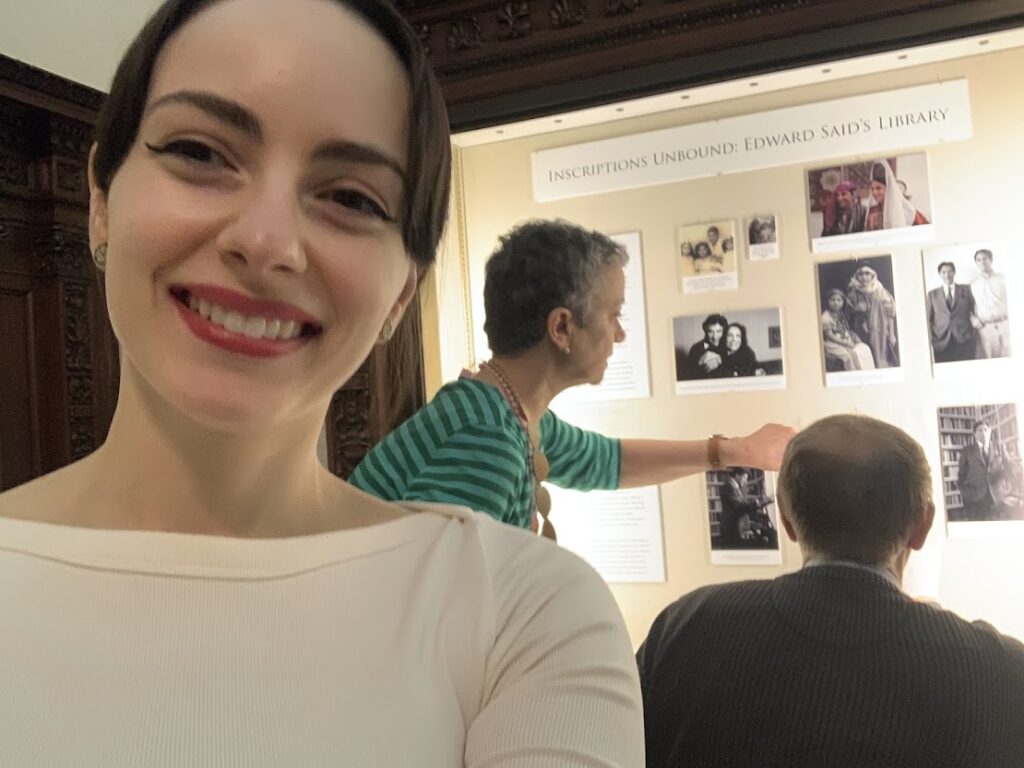 My title is Pleasure Al-Nemri. I maintain a BA in Anthropology with a focus in Center Japanese Research from Bard Faculty and I’m additionally a graduate of the Center Japanese, South Asian, and African Research, MESAAS Division at Columbia College, the place I earned an MA in Might 2024. I’m at the moment concerned in a analysis venture on the Center East Institute. My MA thesis explored among the methods wherein Moroccans and Tunisians relate to Palestinians. Drawing on three months of participant observations and interviews I performed in Morocco in 2022 and in 2023, my analysis sought to know how North Africans relate to the Palestinian battle on a private, experiential stage, and what these totally different types of identification and solidarity reveal about group identities within the area. Up to now few years, I’ve additionally performed two Institutional Assessment Board Accredited ethnographic research on Arabic-speaking refugees in Greece and Connecticut. I’ve expertise in refugee advocacy, educating, translating, and main DEI workshops. My scholarly pursuits embrace exploring the family tree of anti-Blackness in Arabic-speaking contexts, Palestine solidarity, and the way refugee crises are framed.
How did the concept of the exhibit come to you?

The exhibit got here to me in phases. Throughout my first semester at Columbia, my buddy, Anna Tyshkov–a current Columbia Anthropology alumnae–took me on my first go to to the Edward Mentioned Studying Room. She instructed me that she would typically work within the Mentioned Studying Room and that she loved wanting by way of Mentioned’s books on her breaks. The room quickly grew to become my favourite place to review on campus. I couldn’t imagine that I used to be surrounded by the books that formed considered one of my most cherished thinkers. I might leaf by way of the pages of the books, and picture a way of mental closeness to my aspirational mentor, Edward Mentioned.
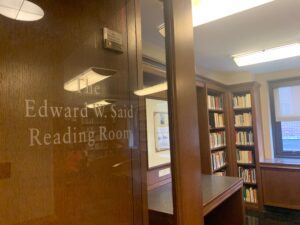

Within the Fall of 2022, I used to be enrolled in Professor Brinkley Messick’s “Written Tradition” course. The course supplied an exquisite alternative to suppose extra deeply about numerous types of texts, inscriptions, and archives. I might typically go to Prof. Messick’s workplace hours that semester, and through considered one of our early discussions, the subject of Edward Mentioned’s books and library got here up. Prof. Messick proposed an thought, and shared {that a} graduate scholar who had since graduated, had really began wanting by way of a few of Mentioned’s books which are housed within the Center East Institute. These have been books that didn’t make it to the Edward Mentioned Studying Room in Butler Library, however have been nonetheless donated to Columbia College. I used to be thrilled to seek out two full cabinets price of books on the MEI, and to my shock, many had inscriptions inside their fly leaves from main intellectuals, which intrigued me and piqued my curiosity: the earlier graduate scholar had additionally observed this, and had began to annotate an inventory with the names of the donors of those books and of their dedications and messages to Mentioned. I got here again to Prof. Messick and shared my enthusiasm for this venture, and proposed that I might choose up the place the scholar left the venture. Prof. Messick was enthusiastic and totally supportive. The MEI’s Arcapita Visiting Professor on the time, Dr. Islam Dayeh, had additionally expressed enthusiasm for the venture, and brought on a school supervisor position for the primary stage of this venture.
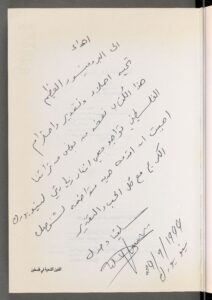
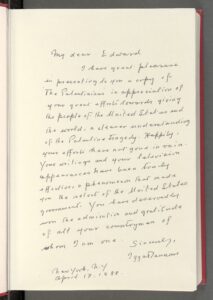

Later within the spring of 2023, Prof. Messick advisable that I share the inscriptions with Edward’s spouse, Mariam Mentioned. That is when the oral historical past part of the venture developed. I bear in mind my sturdy emotions when Mariam instructed me many tales about Mentioned’s connections to Palestine. It was particularly significant to me that these conversations have been going down in the course of the week of the seventy fifth anniversary of the Nakba, a devastating milestone for my household and the Palestinian group at massive. Over the next yr, I might share all the inscriptions I discovered with Mariam and we’d discuss endlessly. Mariam was stuffed with tales and she or he helped convey invaluable context to the inscriptions, the folks behind them, and their relationships with Mentioned. Her steerage was instrumental in serving to me curate the exhibit, as I needed to choose solely 49 inscriptions to showcase out of a whole lot. She was so sort to open up her house to me, give me her time, and share her private picture assortment along with books from her condo that I assumed would assist add depth and context to the exhibit.
The Head of International Research, Kaoukab Chebaro, and the Center East & Islamic Research Librarian, Peter Magierski, additionally spent numerous hours guiding me by way of every stage of the venture. Kaoukab advocated for my venture inside the Libraries, helped me navigate the workflows, and helped form the shape and content material of the exhibit with the utmost care. She helped spotlight key mental subjects and pointed me to key activist figures to incorporate within the closing exhibit. We’d focus on the wireframing for the exhibit, the final ideas, and my write-up and progress in weekly conferences. Amongst many contributions, Peter helped me keep organized and lent his assist to the venture all through its execution: he supplied excel sheets, exhibit mock-up frameworks, and when all was prepared, the three of us (myself, Peter and Kaoukab) spent lengthy hours method into the night pinning the exhibit up with meticulous consideration to element, spacing and general format. I actually couldn’t have completed this venture with out Kaoukab and Peter’s valuable assist and assist. 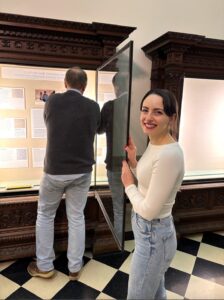
What was the diploma of your familiarity with the Edward Mentioned e book assortment previous to embarking on this curatorial journey? Why did you select to concentrate on the e book assortment quite than on the archival assortment on this exhibit?
It is a nice query! To be trustworthy, I used to be extra conversant in the Edward Mentioned Studying Room assortment quite than the archival assortment. The Studying Room was extra accessible to me and it initially appeared most possible to start the venture by wanting on the books housed within the Center East Institute and the Studying Room. If given the chance, I might love for an opportunity to broaden upon my work and look by way of the archival assortment. I’m certain there are numerous treasures there that may doubtless have a lot resonance with the inscriptions I’ve discovered, and would deepen and broaden the narrative I pointed to by way of my number of the inscriptions within the books. Rather more must be instructed about these tales than I used to be capable of with this exhibit.
How great! Extra to sit up for. Hopefully, this may be continued at some stage. What was the curatorial course of or precept you adopted, and the way did you provide you with the varied window themes?
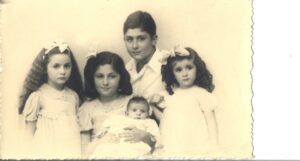
After discovering a whole lot of inscriptions, I had the painful job of narrowing down which tales I might share. Mariam and Kaoukab have been most useful to me. I needed to choose and select whether or not or not I might prioritize an inscription based mostly on the inscriber, their relationship with Edward, and the standard of what they wrote, and the general narrative I needed to convey. This was the toughest factor for me: to study to let go, to prioritize and suppose by way of the right way to write an exhibit and a label in 100 phrases, quite than in 2000 phrases or extra, as in writing a scholarly paper or report. After narrowing down some names, I made a decision early on that I needed every window theme to characterize the title of considered one of Edward’s books. I then linked the inscriptions to the e book themes that appeared to take advantage of sense. Within the later levels of the curation, I made a decision to have an introductory window and made the ultimate alternatives of images from the Mentioned household’s private assortment.


Which window, or which gadgets from the exhibit are your favourite, and why?

It is a very arduous query for me to reply, however I must say that After the Final Sky: Palestinian Lives is my favourite window. I like how Jean Mohr’s pictures from the e book assist showcase the sweetness and resilience of the Palestinian folks. These pictures are juxtaposed with inscriptions from Palestinians whose gratitude and love for Edward shine by way of. This exhibit just isn’t solely a commemoration of Edward Mentioned as an individual and public mental, it’s additionally a testomony to the inextricable bonds that the Palestinian group has with the land and one another, regardless of the trauma of the continued Nakba and exile.

What shocked you in regards to the means of curating an exhibit corresponding to this one? What did you study?
This was top-of-the-line studying experiences of my life. Researching and curating this exhibit helped me preserve myself open for surprises. I used to be shocked by what number of inscriptions have been left to each Mariam and Edward–a testomony to how the each of them solid significant private and mental relationships. I additionally was heartwarmed to see inscriptions from many people who didn’t know Edward personally, however felt compelled to ship him books. The character of many of those relationships have been corroborated by Mariam, which I so typically couldn’t have been capable of know in any other case.
The method of curating the exhibit was additionally an awesome mental and writing train. It was my first exhibit the place I wrote for the broader public, quite than for my instructors in a classroom setting. With nice steerage from Kaoukab and Peter, I aimed to indicate, quite than inform tales. The small print from the inscriptions I dropped at focus all through the exhibit embody the connections and narratives I used to be most excited to share.


What have been among the challenges and rewards you encountered?
This venture introduced me immense pleasure and luxury throughout an extremely tough and emotionally charged time. Whereas there have been many challenges that I confronted all through this endeavor, I really feel grateful for all the methods I discovered to navigate by way of every concern that arose. It was my first time doing archival work–not to mention with over 4,000 books housed in three totally different places. I started the venture by wanting by way of about 1,000 of Edward’s books that have been situated in an workplace within the Center East Institute. Whereas most of those books have been on the cabinets, two years later I paid nearer consideration to six massive cardboard containers that I found held dozens of Edward’s books. These containers have been sealed for almost 20 years and nobody actually had the bandwidth to account for them.
There have been logistical challenges and issues of entry, too: the second part of the venture befell in Butler Library’s Edward Mentioned Studying Room. Whereas I had began wanting by way of the books within the Mentioned Studying Room previous to October 7, 2023, there was a interval within the Spring of 2024 coinciding with the scholar protests and the locking of the campus to important employees solely: I needed to wait till campus reopened to guests to renew my work.
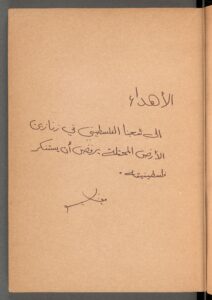
On the rewards entrance, I cherish the chance I used to be given to work by way of the fabric on this method, nearly as an ethnologue–what can the trajectories of books inform us in regards to the individuals who cherish them? — I dug into the inscriptions–each terse and longer-form letters– that had been hidden inside the bindings of Edward Mentioned’s books for many years, with curiosity and actual pleasure. It was additionally rewarding for me to share these inscriptions along with his spouse, Mariam Mentioned, and assist her recount misplaced reminiscences and uncover new connections.
Are you planning any occasions to go together with the exhibit?
Sure! I’m planning a chat at Columbia later this spring that may go into extra element in regards to the venture and my findings. I hope to ask Mosab Abu Toha, who based the Edward Mentioned Public Library in Beit Lahia, North Gaza in 2017. This was Gaza’s first English language library and it was tragically destroyed by Israel on January 22, 2025 throughout its ongoing genocidal marketing campaign towards Palestinians. I imagine that Mosab’s personal work will assist complement and shed new gentle alone work. After the exhibit is taken down on the 77th anniversary of the Nakba (Might 15, 2025), I hope to put in a part of it in Knox Corridor, with the Center East Institute. Inshallah, extra occasions to return!
If there may be one message you’ll convey to the viewers of the exhibit, particularly the scholars, what would it not be?
The story that emerges from this exhibit is considered one of a person greater than life, a dedicated public mental with an excellent and daring thoughts in addition to vastly spectacular erudition; a humorous and witty interlocutor; a heat buddy; an exacting and beneficiant trainer; a curious and engaged colleague; however most of all, a brave humanist who spoke reality to energy. These dedications reveal the enduring legacy of a person whose ardour for social justice and mental integrity proceed to encourage and form discourses throughout generations, particularly round Palestine and justice for Palestinians.
Thanks, Pleasure! What a pleasure to work with you, and what a journey! I want you the most effective of luck with all of your subsequent tasks!
Kaoukab Chebaro, International Research, Head, Columbia College Libraries
For inquiries relating to the Edward Mentioned Studying Room, e-mail Kaoukab Chebaro, International Research, Head: kc3287@ columbia.edu
For inquiries relating to our in depth Center Japanese Research collections, e-mail Peter Magierski, Center East and Islamic Research Librarian: pm2650@columbia.edu
For inquiries relating to the Edward Mentioned archival papers or to e book an appointment, e-mail RBM: staffrbml@library.columbia.edu

