


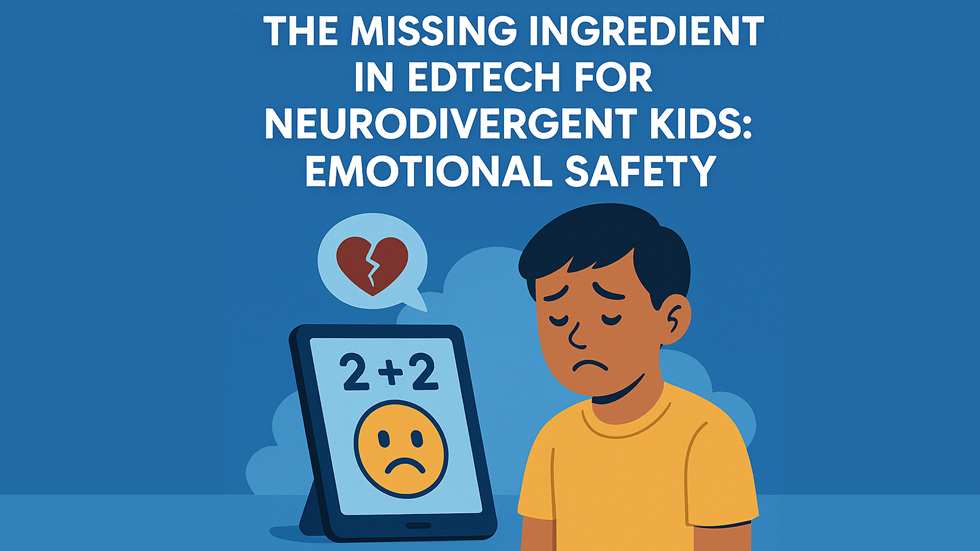
A thirteen-year-old checked out me throughout certainly one of our classes and mentioned, “I’m 13, however apps deal with me like I’m 6.”
He wasn’t speaking about studying ranges. He was speaking about dignity.
Over the previous few months, I’ve listened to a really giant variety of households with neurodivergent kids – youngsters with autism, dyslexia, ADHD, or twice-exceptionality. Every story is totally different. However the emotional panorama is remarkably constant. Practically each dad or mum describes a toddler who has discovered to affiliate studying with stress. Practically each little one tells me some model of the identical factor: studying instruments don’t really feel secure.
When Apps Develop into Menace Alerts
Most EdTech platforms are constructed round efficiency. They measure, observe, grade, and examine. They assume a toddler arrives regulated and able to be taught. An assumption that excludes neurodivergent learners who navigate the world with heightened sensory, cognitive, or emotional load. For these youngsters, studying isn’t a straight line. It’s a state that relies upon fully on how secure they really feel in that second.
The patterns I’ve noticed are not possible to disregard. Youngsters repeatedly describe digital instruments as evaluative quite than supportive. One little one instructed me, “It seems like I’m being examined, not helped.” A dad or mum described her son shutting down the second directions seem as a result of he anticipates failure earlier than he even tries. These aren’t remoted reactions. They level to a elementary want most instruments aren’t designed to fulfill.
Neurodivergent learners typically describe a mismatch between their inside rhythm and the rhythm the app calls for. A number of kids instructed me they wished they may management the tempo or pause with out being penalized. by timers or automated corrections. Households saved repeating the identical thought: the educational expertise must adapt to the kid, not the opposite approach round.
The Dignity Hole
Many kids defined that directions assume invisible data. One lady instructed me she may perceive the idea however not the “how.” When she missed the nuance, it felt like a private failure quite than a niche in design. Her mom described it as “falling by cracks that nobody else sees.”
Maybe most painful is how instruments interpret dysregulation. When neurodivergent kids really feel anxious or overstimulated, most platforms merely learn it as disengagement. A dad or mum as soon as instructed me, “The app thinks he’s not attempting. That’s not the reality. He’s overwhelmed.” The instrument doesn’t acknowledge this emotional shift, so the kid believes the failure is theirs alone.
Older neurodivergent learners face one other burden: infantilization. A fourteen-year-old summed it up clearly: “I can’t learn very nicely, however I’m not silly.” I’ve seen twelve-year-olds who can talk about quantum physics battle with “The cat sat on the mat.” When digital instruments wrap easy phonics in cartoon animals and first colors, they strip away the sense of identification these older learners are desperately attempting to construct.
What Emotional Security Truly Means
All these experiences level to the identical lacking ingredient: emotional security. It’s the situation through which a toddler feels seen, revered, and unthreatened. It’s the inspiration for any real studying with neurodivergent kids.
Emotional security isn’t a smooth idea or a bonus function. It’s a design precept. When it’s absent, kids shield themselves by withdrawing. When it’s current, they try issues they often keep away from. They take dangers. They keep curious. The whole studying system adjustments.
Designing for emotional security means particular, concrete selections:
- Empower kids to handle their very own tempo. Embrace seen pause buttons, let youngsters set their very own timer intervals, and keep away from computerized development. Youngsters ought to resolve when to proceed.
- Supply clear, step-by-step explanations. Assume nothing is clear. When a toddler doesn’t perceive, the design failed. Not the kid.
- Construct age-respectful content material. A twelve-year-old fighting easy phrases can interact with tales about area exploration or historical civilizations, so long as the sentence buildings meet them the place they’re.
- Take away comparability. No leaderboards. No streaks that disgrace when damaged. Personal progress monitoring that celebrates what they can do, not what they will’t.
- Acknowledge emotional state as a part of studying. A toddler’s temper on Tuesday would possibly require fully totally different content material than their temper on Thursday; even when their talent degree hasn’t modified.
From Accessibility to Dignity
Most essential, emotional security requires listening earlier than constructing. Each significant change I’ve seen has come from listening to kids clarify what hurts. Emotional security can’t be added on the finish. It grows out of understanding what overwhelms, what confuses, and what restores confidence.
We speak loads about accessibility. We speak far much less about dignity. But dignity is perhaps precisely what neurodivergent learners want most. A studying instrument that treats a toddler with respect adjustments how that little one sees themselves. It offers them permission to develop with out worry of being judged or misunderstood.
The way forward for neurodivergent studying received’t be constructed solely on content material, algorithms, or interfaces. Will probably be constructed on the quiet, affected person work of serving to kids really feel secure sufficient to be taught within the first place.

