



Hearken to my interview with Mitch Weathers (transcript):
Sponsored by EVERFI and The Wired Classroom
This web page comprises Bookshop.org hyperlinks. While you make a purchase order via these hyperlinks, Cult of Pedagogy will get a small share of the sale at no further value to you. What’s the distinction between Amazon and Bookshop.org?
Most of my instructing expertise was in center faculties, so I spent numerous time with children who have been going via some of the tumultuous transitions of their lives. As they moved from an surroundings the place adults structured each second to at least one with way more autonomy, fairly a number of of our college students struggled to handle their time, their consideration, their belongings, and their power in a method that helped them do faculty efficiently. They’d overlook to do assignments. Lose complete notebooks. Present as much as class empty-handed. On daily basis after they rushed out on the finish of the college day, the halls have been suffering from deserted pencils, folders, calculators, books, and papers … so many papers.
And whereas a lot of them managed to determine these items out finally, we at all times had a gaggle who didn’t, who gathered a collection of clean areas within the gradebook, whose lockers and backpacks have been pure chaos, and whose efficiency on assignments and assessments usually put them on the very backside of the category. We might have conferences with these college students the place we urged them to “get organized” and “sustain with their work.” Generally we’d assist them clear out their lockers or arrange a system the place they needed to write down their homework of their task guide and get it checked by each instructor all through the day, and typically these interventions labored for some time, however wanting again, I don’t keep in mind any of it being notably efficient.
I additionally keep in mind one thing else: Collectively, as academics, we might be fairly judgy about these children. Once we mentioned their points, you’d hear issues like “That child is a large number” and “She simply doesn’t sustain along with her issues,” and even “He doesn’t care about faculty” or “She’s not motivated.” The underlying perception, whether or not we realized it or not, gave the impression to be that if these children needed to do higher, they might.
Again then we didn’t know the time period govt features, which is a set of abilities all of us use to manage our consideration, provoke duties, handle time, and preserve ourselves organized. A few of us choose up these abilities from the folks round us, a few of us develop them naturally, and a few of us actually battle with them. Happily, educators have gotten way more conscious that whether or not or not an individual has mastered govt features has nothing to do with their character, and that in reality, these abilities will be and needs to be taught, not solely to college students who show a necessity for them, however to all college students.
The problem with instructing these abilities, nevertheless, is time. Academics have already got sufficient to do with out including extra to their plate, so a complete separate curriculum on govt features wouldn’t be real looking.
That’s the place Mitch Weathers is available in.

Weathers has developed a system for embedding govt features into any instructor’s common schedule. It doesn’t take numerous time, it’s not notably troublesome to be taught, it leaves loads of room for instructing your common classes as deliberate, and reasonably than being “yet one more factor,” it ought to make it extra seemingly for college kids to soak up your materials and do nicely in your class. He shares this method in his new guide, Government Features for Each Classroom, and after studying it, I’m an enormous fan. As I used to be studying, the thought that saved occurring to me was man, if everybody did this, so many children would achieve this a lot better at school, they usually’d take pleasure in it extra too.

On the podcast, Weathers provides us an outline of how his system works. You’ll be able to hearken to the episode on the participant above, learn the full transcript, or learn my abstract beneath.
The Case for Educating Government Features to Everybody
If just some children battle with govt functioning abilities, why train it to all college students? In our dialog, I discussed that in my expertise, I had most frequently seen these abilities taught to college students who had IEPs, college students who spent some a part of the day in a useful resource room with a instructor who would put aside time to work on these abilities. Whereas this further help appeared to get good outcomes, it didn’t attain everybody, as a result of many college students who struggled with govt features didn’t have IEPs.
This resonated with Weathers and illustrated precisely the issue he’s attempting to resolve — treating govt features as a Tier 2 or 3 intervention, after they actually needs to be Tier 1. (That is in reference to the Multi-Tiered System of Helps framework, the place a Tier 1 intervention is taught to most college students and is taken into account proactive, whereas larger tiers — 2 and three — are put aside for smaller teams of scholars who want extra help.) He argues that by instructing these abilities to all college students, we cut back the cognitive demand on everybody, thus liberating up extra “psychological energy” for use on educational progress. We additionally take among the pressure off of those that present tier 2 and three interventions.
His authentic inspiration got here from the big inhabitants of multi-language learners he labored with early in his profession. Watching the hassle it took for them to only get via a college day made him begin trying to find options.
“On the finish of the college day,” he says, “you can simply see a fatigue that my college students have been carrying that they didn’t in the beginning of the day. While you examine that with their English-speaking friends, there’s a big cognitive load to only navigating the college day. If I’m utilizing a big variety of psychological energy simply attempting to translate all the pieces I’m studying, going class to class to class with completely different expectations, completely different routines, completely different curriculum, you’re simply — that bandwidth is diminished.”
He began his every day routine along with his personal college students, and when it labored nicely, the system caught on throughout the ninth grade the next yr. Finally he made his system obtainable to anybody via his Organized Binder program, and now via his guide.
The System
Weathers’ system is constructed round a every day routine that occurs within the first couple of minutes and the previous couple of minutes of a category interval. He’s cautious to level out that this isn’t a curriculum, that it’s not further content material to be taught. “As a result of whether it is,” he says, “academics usually are not going to have the ability to match it in.”
This method layers proper on prime of a traditional class interval — a couple of minutes in the beginning and some minutes on the finish. Within the center is instructing a lesson nevertheless you would possibly usually do it. Right here’s what the steps appear to be:
Step 1: The Kickoff
This can be a low-stakes immediate that will get college students to have interaction with beforehand realized materials. This temporary retrieval follow prompts their working reminiscence and prepares them for the day forward. College students document all of their responses to those on a kind known as the Weekly Lifeline, the place in addition they document their end-of-class reflections:
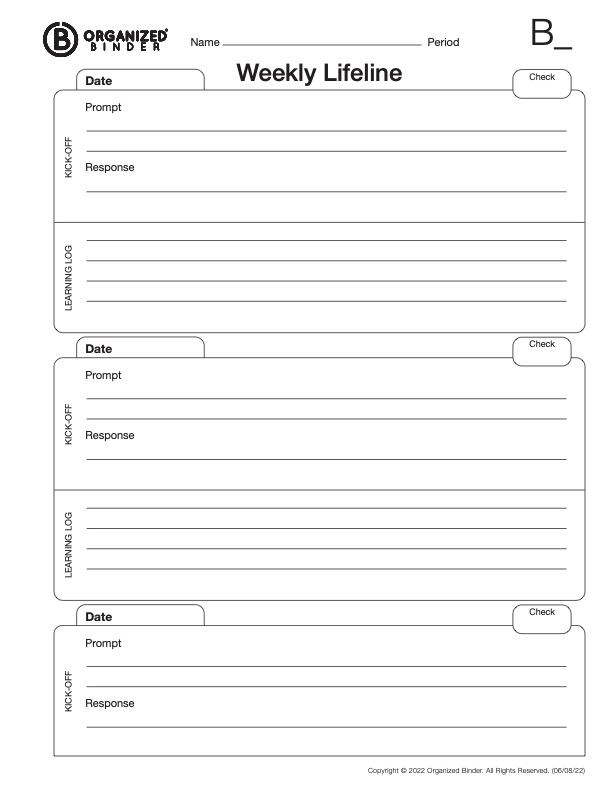
If this feels like a bell-ringer to you, you’re not unsuitable, however in contrast to typical bell-ringers, which college students are anticipated to do as quickly as they stroll in, this one doesn’t begin till everybody is able to start collectively.
Weathers explains why he made this shift: “What I usually see is that immediate is on the market for college kids the second they enter the educational area. And what I began to acknowledge is one, I might have college students that might present up early, so they might begin and attempt to get to the following step of the routine. Then there have been college students who have been coming from an extra a part of the campus, they usually have been nonetheless on time or possibly confirmed up tardy. I had created a state of affairs the place, as a result of all of us arrive at completely different occasions, we’re all elsewhere.”
By beginning everybody on the similar time, after the bell rings, all of them interact within the work of studying collectively. Within the minutes earlier than that, college students are sharpening pencils and getting their binders — Weathers’ system depends on college students holding sure objects (which you’ll see beneath) in a 3-ring binder. He calls this time “the work of on the brink of be taught versus the work of studying.”
Step 2: Agenda
On this step, the instructor takes a minute to introduce the plan for the day, and college students write it down in a chart just like the one beneath.

“For a lot of college students,” Weathers says, “life outdoors of college is something however predictable, and it may possibly even skew in direction of chaotic. And so the extra predictability I can convey for these kiddos, the higher. It has a profound impression, simply taking a second to introduce the lesson and college students are making a log of that. It helps college students who’re absent know precisely what we did, and there’s one other piece there: Each instructor in the beginning wants somewhat little bit of time for enterprise.”
Weathers encourages academics to make use of this time to mannequin the ability of holding a calendar, a necessary life ability that many individuals are by no means taught.
Step 3: Desk of Contents
At this level, the instructor distributes any handouts, sources, or returned assignments to college students for the day. These go into the binder and are recorded on the desk of contents, a sheet on the entrance of the binder that itemizes all the pieces behind it.

Pages within the binder are organized chronologically, reasonably than by their operate. Weathers used to have college students set up their supplies in a extra typical method — with sections for notes, homework, quizzes, and handouts — however he discovered that this type of system didn’t serve him or his college students.
“I’d get to the tip of a unit,” he says, “and we’d have our summative evaluation or mission due date or one thing, and all of these things was disjointed. And I used to be like, there’s no cohesion right here.” As a result of items are sometimes taught thematically, Weathers felt that each one supplies for a unit needs to be grouped collectively within the order through which they have been offered, with every merchandise assigned a quantity. This method makes it apparent when an merchandise is lacking, which helps college students preserve monitor of all their assignments.
This can be a good time to say that the instructor retains a category binder that’s an actual mannequin for what college students preserve in their very own binders; this is a vital useful resource for college kids after they return from an absence.
As soon as the unit is full, the papers and desk of contents will be bundled collectively and filed away so the binder is recent for the following unit.
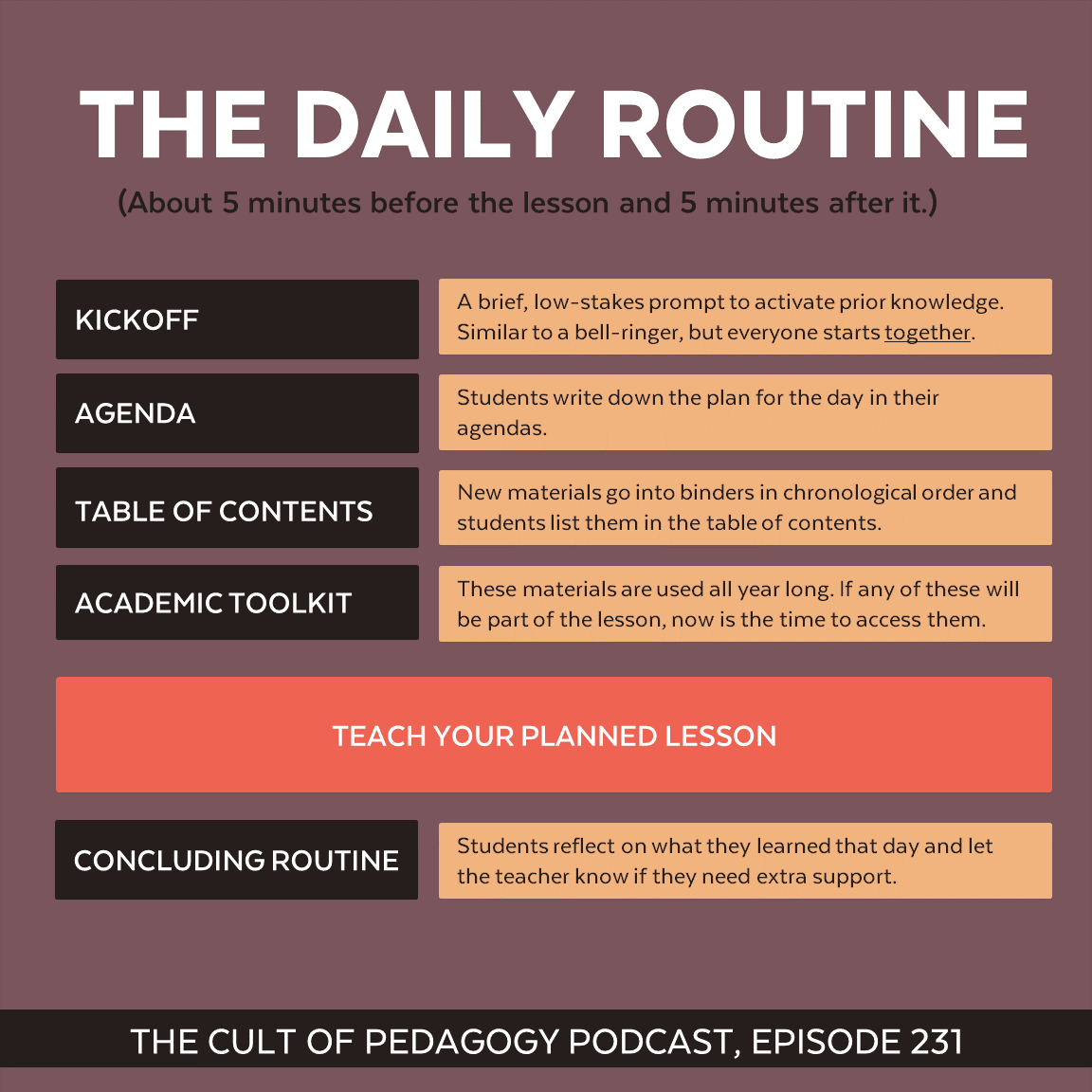
Step 4: Tutorial Toolkit
The educational toolkit is a separate part within the binder the place college students preserve sources which are used year-round, issues that aren’t tied to any specific unit. This “step” within the system doesn’t present up on daily basis, solely on days when one thing is being launched to that toolkit or when college students might want to entry one thing from it. In any other case, the category strikes on to the following half:
Subsequent: Train Your Lesson As Regular
All the above steps simply take a couple of minutes to finish. Once they’re performed, the instructor can start no matter lesson they’ve deliberate for the day. That is the great thing about Weathers’ system: It not solely takes little or no time away from the category interval, however as a result of it will get them organized and prompts their working reminiscence, it additionally units college students as much as be taught higher in the course of the lesson, and that lesson takes up the majority of the category interval, because it ought to.
Step 5: Concluding Routine
In the previous couple of minutes of sophistication, college students return to the identical sheet they used for the kickoff and write a mirrored image on what they realized that day.
Weathers sees this as a chance for formative evaluation. “There is no such thing as a extra highly effective formative suggestions than communication with a pupil one on one,” he says. “And the way we promote it to college students is this can be a non-public one on one dialog between you and I. For those who need assistance, that is the place you’ll be able to inform me.”
“I Acquired This.”
Weathers has been utilizing this method for thus lengthy that a few of his earlier college students at the moment are academics who use the Organized Binder system themselves as a result of they’ve skilled how nicely it really works. He attributes this not simply to the tutorial success it may possibly convey, however the best way the talents construct confidence.
“As a byproduct of collaborating on this studying routine with my friends,” he says, describing the coed expertise, “I get follow with and see modeled these govt functioning abilities. So not solely do I’ve this sense of, like, I do know what to do right here, proper, I do know what to do to take part and appear to be everybody else within the class and I’m engaged. That feels good, there’s little question. However as I’m honing these abilities, there’s an company — I like to make use of the phrase dexterity — form of like, I acquired this. And what I really like for us to recollect is we’re not speaking about grades or check scores or content material or curriculum, the stuff we’re studying. It’s about growing learners, their capability and laying that basis.”
To be taught extra about Weathers’ system, go to Organized Binder.
Be a part of our mailing record and get weekly ideas, instruments, and inspiration that may make your instructing simpler and enjoyable. You’ll get entry to our members-only library of free downloads, together with 20 Methods to Lower Your Grading Time in Half, the e-booklet that has helped hundreds of academics save time on grading. Over 50,000 academics have already joined—come on in.

